
和題:YouTubeを用いた日本語自習システムは、コロケーションのメタ知識を必要とする
Abstract
This study proposed a self-directed learning system that extracts subtitle information from YouTube videos and presents it as learning vocabulary. In recent years, Japanese language learners’ interests have become more diverse, with easy access to multilingual information through SNS. Thus, it is assumed that there are many potential learners not enrolled in Japanese language institutes or less-than-learners. This study proposes a system for learners to learn Japanese from desired YouTube videos. The basic concept of the system is to extract subtitle information from 10 videos and present high-frequency words. The results of frequency analysis and co-occurrence analysis showed the feasibility of this system. At the same time, it was suggested that the characteristic words of each video should be presented together with their collocations and that meta-knowledge of their usages is required.
Backgrounds
Motivations for language learning are becoming more diverse as contact with multilingual information through SNS is becoming more common.
SNSを通じた多言語情報への接触が一般化し、言語学習の動機が多様化している
Therefore, it is expected that the number of potential ‘less-than-learners,’ who are not explicit learners in the classroom, is increasing
したがって、言語教育機関にいる学習者ではない、潜在的な「学習者未満の学習者」が増えていることが予想される
Leaners and Less-than-learners
The number of learners: 3.8million
Number of institutions: 18,272 (second highest ever)
Number of teachers: 74,592 (2nd highest ever)
Learners: 3,794,714 (3rd highest ever)
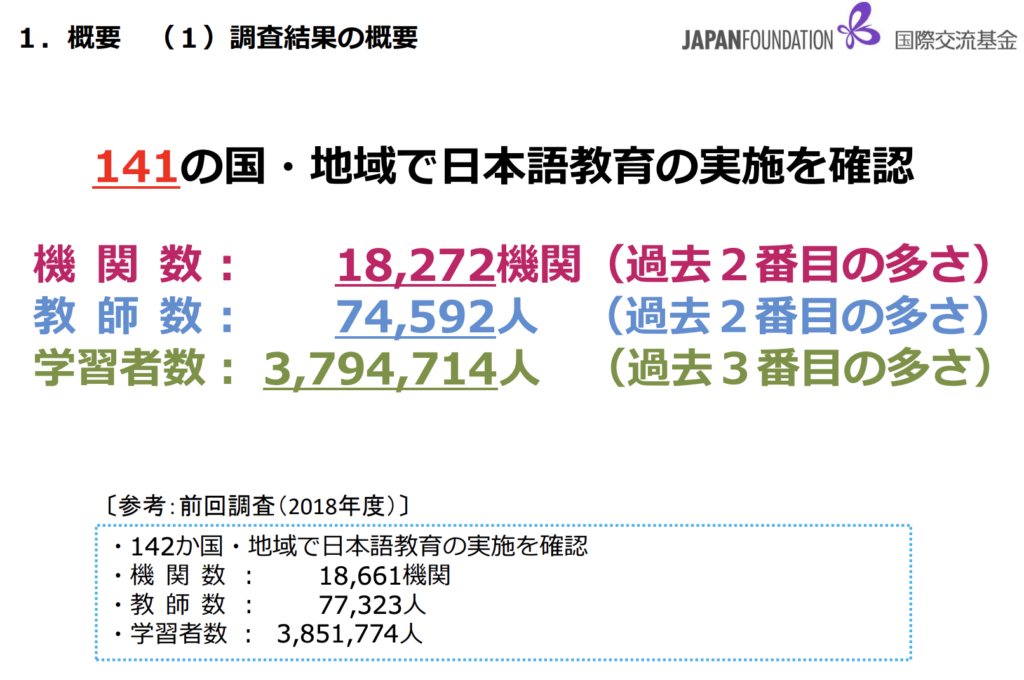
結果概要“, Japan Foundation, Dec. 2021
Less-than-learners
Less-than-learners is my original term, it refers to the learners out of school, and people who actively contact Japanese content.
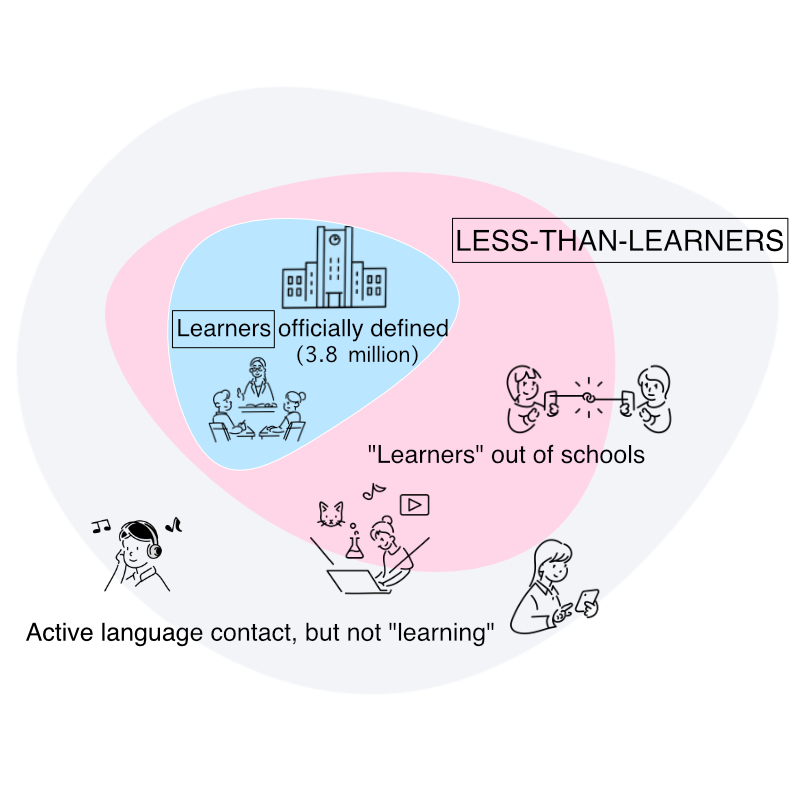
Aim of this study
To propose a self-learning system that allows learners to watch their favorite Japanese-language YouTube videos and learn the vocabulary and grammar used in videos.
学習者が自分の好きな日本語のYouTube動画を見て、その動画で使われている語彙や文法を学習できるシステムを提案する
Method
Outlines of the system
INPUT YOUTUBE LINKS → GET A VOCABULARY LIST
This system is planned as a web application.
Learners will select their Japanese level and input links of videos they want to watch.
In order to obtain a sufficient word size for the co-occurrence analysis, it is desirable that the links be entered for approximately 10 videos of 10 minutes in length.
If the video length is for several hours, such as a video of a live game, a single video link would be sufficient in size.
共起分析に十分な語数を得るため、10分の動画10本程度のリンクが入力されていることが望ましい。
ゲーム実況の動画など動画の長さが数時間の場合は、動画リンクは1つで十分な語数となる。
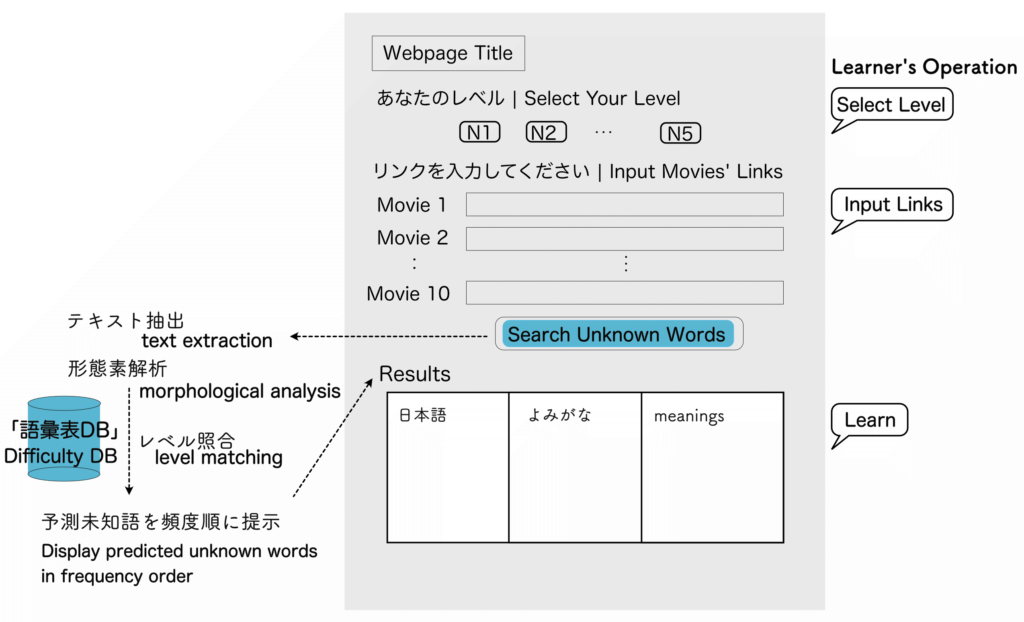
How to use the self-learning system
- Visit the system website
- Select your Japanese language level
- Enter 5-10 links to the videos you want to watch
- Press the [Search] button
- Learn the displayed list of words and grammar list
- Watch the video you want to watch
PROTOTYPE: Video Materials
Cooking-related YouTube
include various genres such as; recipes, cooking, mysterious dishes, eating huge volumes, and videos in which the eating sound is played
Of these, this study will use the “Kimagure-Cook” channel
(which has the largest number of subscribers among cooking-related Japanese YouTube channels)
Material YouTube Movies
All by “Kimagure-cook”, titles modified.
- 1匹17万円!世界最大のカニ『タスマニアキングクラブ』をさばいて食べてみた!, 2019. https://www.youtube.com/watch?v=DpK6vo4_sX4.
- 巨大イカのさばきかた, 2019. https://www.youtube.com/watch?v=qmuxw4iZvjU.
- 【一人BBQ】市場で見つけた ばけものサイズの『岩牡蠣』炭火と生牡蠣で食いまくる!, 2020. https://www.youtube.com/watch?v=D4Qz0Vscm0o.
- 元気過ぎて台所をかけまわるマダコをしめて。ぶったぎりにしてワサビで漬け込む料理。, 2020. https://www.youtube.com/watch?v=I_HX9dW49BU.
- 全身『水』のフグのお腹の中身が・・・。こんなん食べてるの!?, 2019. https://www.youtube.com/watch?v=_nvAfEov9pY.
- 巨大トラフグさばいてみた!, 2018. https://www.youtube.com/watch?v=zRbV08ykKTM.
- 水死したエイの腹の中を綺麗に掃除してさばいて料理してみた, 2018. https://www.youtube.com/watch?v=gIYbo3nN72E.
- 育ちすぎてしまった巨大な危険生物ニシキエビ。すべてが規格外。生きたままさばいて食べた, 2019. https://www.youtube.com/watch?v=Rx-xTpxeOUQ.
- 200キロのサメをさばいたらお腹の中がすごかった, 2018. https://www.youtube.com/watch?v=W-y-rONjNTc.
- 【衝撃映像】キングサーモンのお腹の中身がイクラまみれだった, 2018. https://www.youtube.com/watch?v=HQEaFT7Q0nk.
| Tokens | 18,502 |
| Types | 2,800 |
| Sentences | 1,952 |
| Paragraphs | 1,845 |
| H1 (Movies) | 10 |
Analysis 1 | Frequency
(1) Frequency analysis -> display frequent words, and analyze the corpus structure
頻度分析→頻出語の提示, コーパス構造の分析
(2) Co-occurrence analysis of characteristic words in each of the 10 videos
To display core words to understand each movie
各動画の特徴語10語の共起分析 (動画理解の鍵になる語を提示)
High-Frequency Words
High-frequency words (top 100 words, frequency over 8 times)
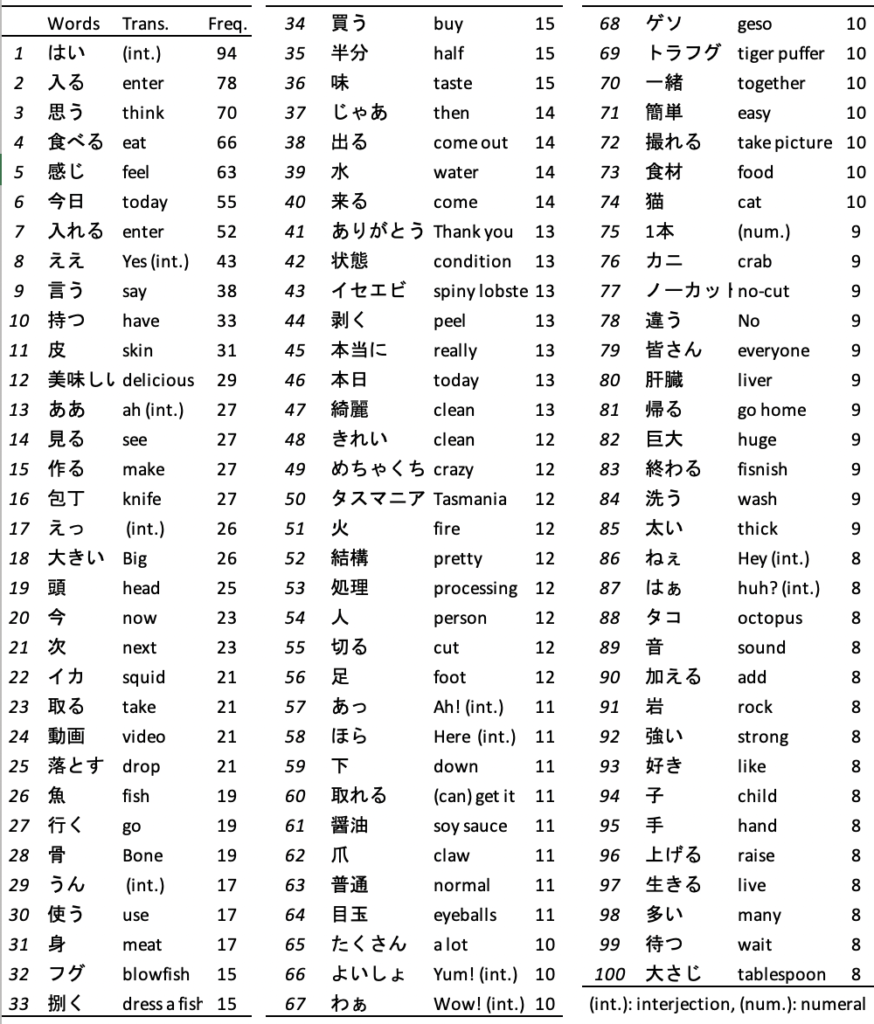
Corpus structure
General structure
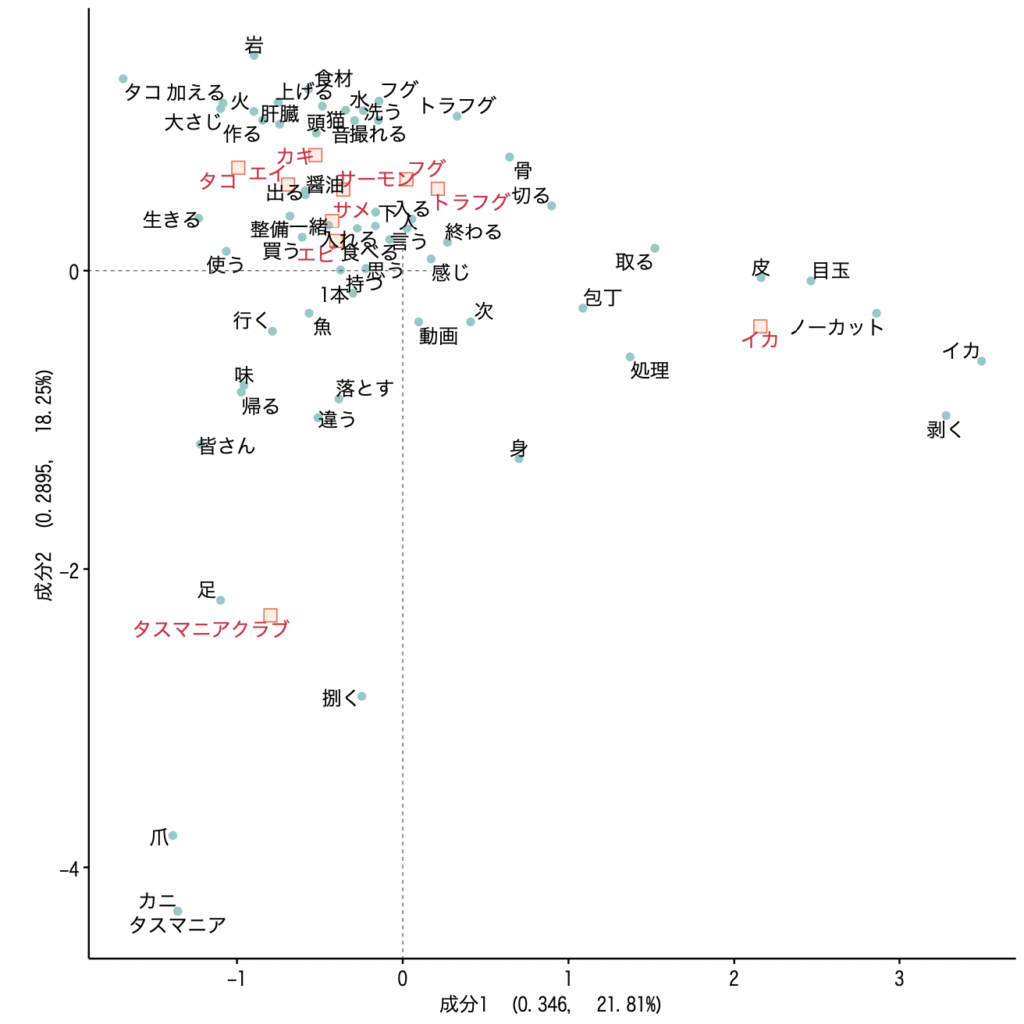
Fig. 2 shows…
Tasmanian crab and squid videos contain several characteristic words.
In the Tasmanian crab video, words such as Tasmania, crab, claw, and legs seem characteristic.
In the squid videos, words such as squid, uncut, eyeball, skin, and processing are characteristic.
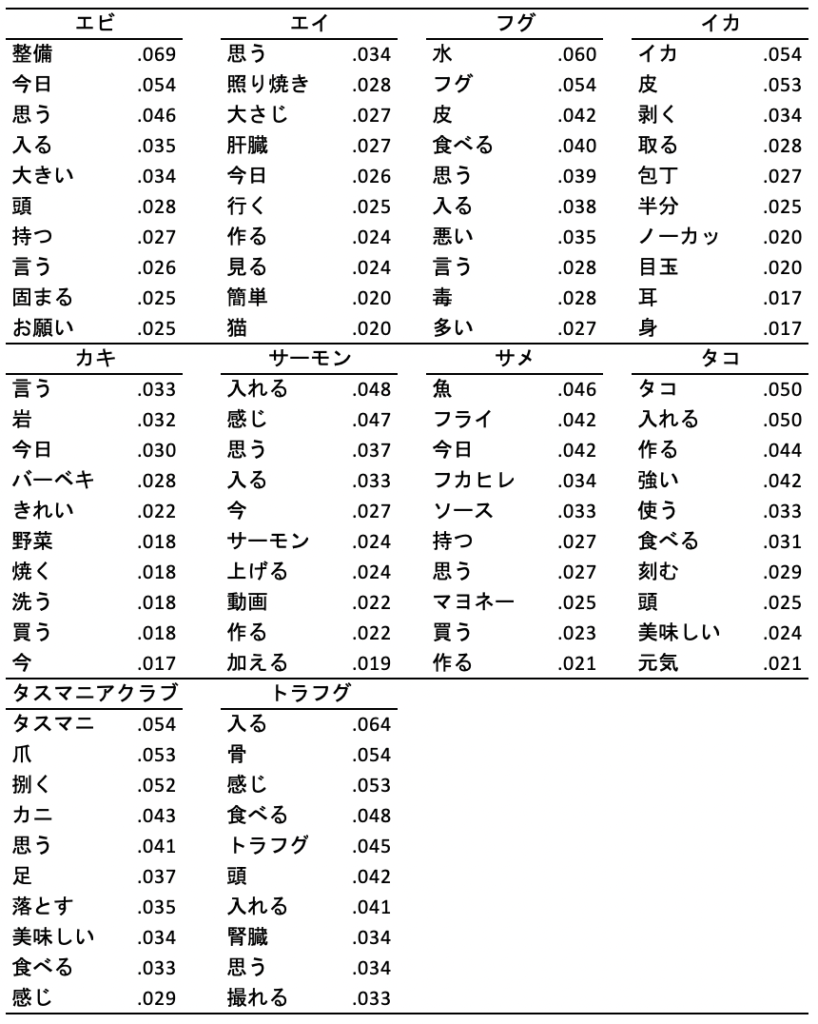
Characteristic words for each movie
Analysis 2 | Collocation
This section analyses the collocation of feature words in the Tasmanian crab and squid videos.
ここでは、タスマニアクラブとイカの動画における特徴語のコロケーションを分析する。
Collocations in Tasmanian club video
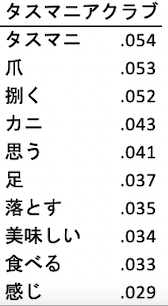
The main collocations of “爪claw” [2nd] were ‘足legs’ and ‘落とすdrop’.
The main collocations for ‘捌く[3rd] /sabaku/ dress or process (a fish)’ were ‘思う think’ and ‘魚 fish’.
The usage of ‘思う[5th] think’ was “捌けると思うI think I can dress it” or
“捌いていきたいと思うI would like to process it,” thus no particularity as a collocation was observed.
Collocation in Squid video
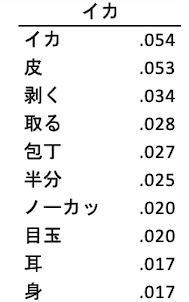
The collocations for “皮 peel [noun]” in second place are;
‘剥く /muku/ peel [verb]’, ‘状態 state’, ‘柚子 yuzu’, ‘引く pull’, ‘感じ feel’, ‘止める stop’, ‘入れる insert’, and ‘剥ける remove’
Summary and Discussions
In this presentation, I propose a Japanese language self-learning system that extracts subtitle information from YouTube videos and presents them as learning vocabulary.
本発表では、YouTubeの字幕情報を抽出する日本語自習システムを提案した
As a method of presenting learning vocabulary, I proposed a strategy to present collocation-aware information in addition to the method of creating a corpus from videos and presenting high-frequency words.
学習語彙の提示方法として、動画からコーパスを作成して頻出単語を提示する方法に加え、コロケーションを意識した情報を提示する方略を提案した。
Word usage in YouTube videos has a special frequency structure depending on the genres of the videos.
YouTube動画における語法は、動画のジャンルによって特殊な頻度構造を持っている。
The analysis suggests that while the frequent words can be simply presented, the characteristic words of each video need to be presented together with collocations and meta-knowledge on the word usage.
頻出単語は単純に提示すればよいが、各動画の特徴的な単語は、共起語や語法に関するメタ知識とともに提示する必要がある。
Future research issues are the presentation of the vocabulary according to the learner’s level, the systematization of meta-knowledge for presenting collocations, and the implementation of the system.
今後の研究課題として、学習者のレベルに応じた語彙の提示、コロケーション提示のためのメタ知識の体系化、システムの実装が挙げられる。
Difficulty: Accuracy of speech recognition in free-talk movies
フリートークの音声認識の精度